
Why Formula 1 Fans Aren’t Cheering for McLaren’s Title Fight
After the Las Vegas Grand Prix ended, chatters swirled up around the paddock about a fuel issue and a possible breach of the plank wear for Lando Norris’ car. A few hours later, the FIA released two official documents, citing that both of the McLaren cars were disqualified from the Las Vegas Grand Prix due to excessive wear on their cars’ skid blocks. F1 social media united like never before: they cheered, and they cheered loudly. In Qatar, the McLaren pitwall fumbled again. An early safety car created a free pit stop window, and everyone in the field took advantage of it, except for Piastri and Norris. Their hesitancy to act threw away a comfortable win for Piastri and a podium finish for Norris. With Max Verstappen taking home first place in both races, the Dutchman is now the closest championship rival to Lando Norris. Somehow, we now go into Abu Dhabi with a three-way title fight.
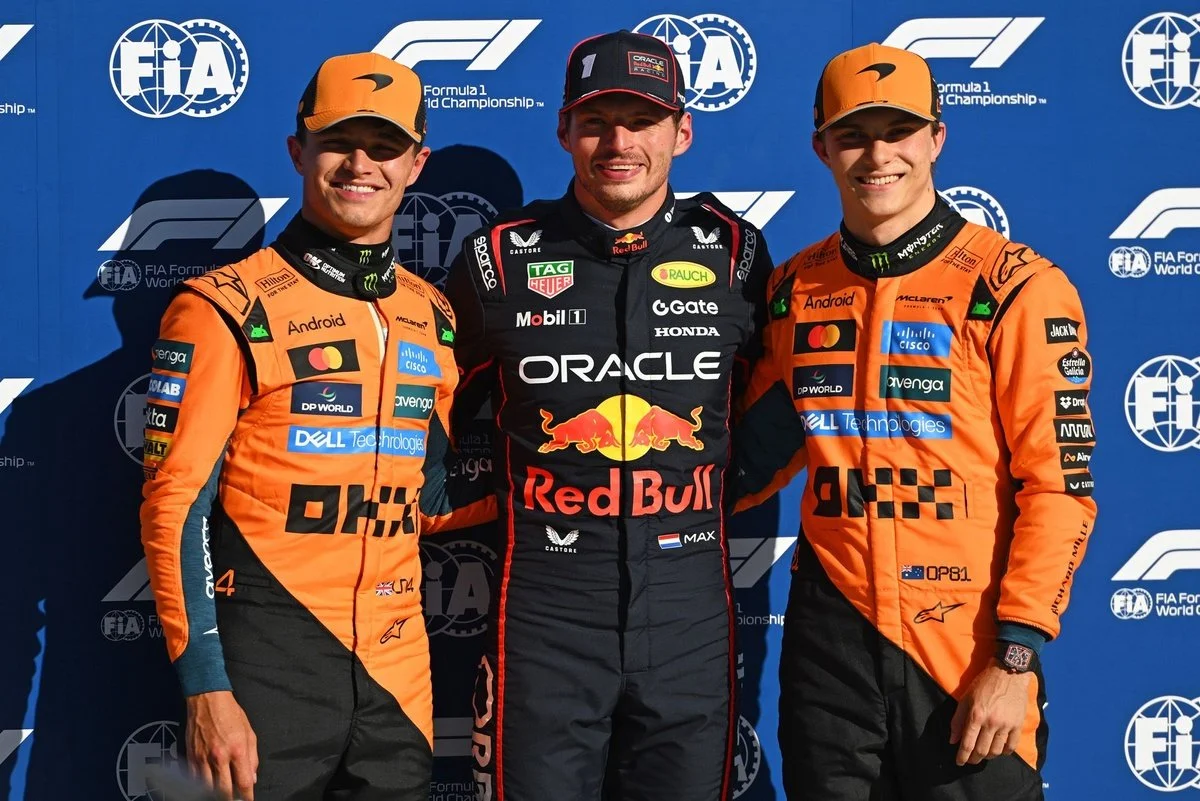
There was a time when McLaren was the heart of the fanbase. The underdog. The inspiring comeback story. For years, McLaren embodied the kind of narrative fans love: the team with so much history fighting its way back from midfield irrelevance, armed with a charismatic young driver lineup pumping out social media content that was adored by the community.
After a wild resurgence in 2024, on paper, everything about McLaren in 2025 should be universally beloved. Their engineering team has developed a car so fast that it cleared the rest of the grid on most race weekends. Yet here we are, staring down the final race of the season… and the internet is quietly, increasingly, shockingly hoping for Max Verstappen to pull off the comeback of the century.
Max Verstappen — the four-time world champion who supposedly “killed the sport” with his dominance in 2023. The man whose driving style was once dissected like a war crime. The man the British media wrote Shakespearean tragedies about during the peak Hamilton years. The man Tifosis boo’ed at everywhere he won. Yet, that man is now the fan favorite. Everywhere he goes, fans are chanting “DU-DU-DU-DU Max Verstappen”.
So, how did McLaren lose the fans’ support? And how did Max Verstappen become the underdog of a title fight he mathematically shouldn’t even be in?
To understand it, we need to start with something fundamental about sports psychology: people love underdogs… until they don’t.
The Papaya Rules Problem
McLaren’s actual downfall in fan perception began not with performance but with philosophy.
In theory, the “Papaya Rules”, aka McLaren’s internal fairness doctrin, should have been applauded. At the beginning of the season, we were glad that McLaren did not have an established No.1 driver. But as the season went on, their commitment to fairness felt like a performative act.
Look at what happened in Monza. It felt like McLaren didn’t know how to manage a team with two championship contenders. Yes, what happened to Norris was unfortunate, but engine failures, slow pitstops, and wrong strategy calls were all part of racing.
The truth is simple:
In competitive sports, complete fairness is an illusion.
It has never existed, and it probably never will.
There is no fair way to manage teammates battling for a title. Hamilton vs Rosberg wasn’t fair. Vettel vs Webber wasn’t fair. Rivalries have a charm because they’re unequal, petty, emotional, and flawed. And McLaren delivered the exact opposite.
Dominance Is Fine — But Where’s the Fight?
Here comes the uncomfortable part.
Norris and Piastri are excellent drivers. They are quick and can deliver great results. Both of them are talented and charismatic in their own ways.
But they aren’t generational yet.
Hamilton and Verstappen weren’t loved only because they won; they were loved because they performed at a level where the driver mattered just as much as the car. Fans felt the hunger in every overtake, every qualifying lap, every title showdown.
Norris and Piastri are rapid on a good day, but both have had moments this season when they crumbled under pressure. It is totally understandable, as this is their first experience fighting for a championship for a full season. But when neither maximizes a car that should deliver easy victories, fans are not happy. It is just the unfortunate nature that mistakes are more noticeable when you are put under the spotlight.
Put bluntly:
Fans can accept dominance, but they cannot accept wasted dominance.
Verstappen doing magic tricks in an inconsistent RB-21 is riveting.
A midfield driver on the podium is beyond exciting.
McLaren occasionally squandering a rocket ship feels narratively unsatisfying.
That’s not entirely “fair”, but it is the reality of audience psychology.
It does not help by the fact that the Norris–Piastri rivalry simply doesn’t exist on track.
Partly because of the regulation: dirty air kills racing, qualifying matters more than before, and strategy offsets from different sides of the garages create separation. Partly because McLaren has engineered a dynamic where conflict is minimized, not encouraged.
We are by no means saying every championship fight had to be Hamilton-Rosberg level of psychological warfare, where they lost their long-standing friendship, or Hamilton-Verstappen level of intensity where they were nearly taking each other out every race. There are ways to race respectfully, while creating exciting on track moments. We got a glimpse of that at the start of 2022 season with Verstappen and Leclerc, until the Ferrari dipped in performance mid-season.
The expectation was that fans were promised a great intra-team rivalry, but what they got was a respectful coexistence. Rivalries require tension and messiness, and that’s what makes people emotionally invested. People aren’t necessarily rooting against Norris or Piastri: they simply haven’t found the rivalry worth investing in.
So, Why Are Fans Cheering for Max Now?
Here’s the strangest twist of the season: Max Verstappen’s reputation has quietly undergone a public rebrand. Not because his previous haters suddenly decided he’s endearing, or because the collective memory of his dominant era has been wiped clean. It’s because sport is emotional, and narratives shift fast. And right now, Verstappen has stumbled into that rarest of archetypes: the unexpected underdog.
No one planned for this. Not the fans, not Red Bull, certainly not McLaren. But the moment Verstappen began closing in on the 104 point gap to Piastri, the storyline changed. He was no longer perceived as the final boss (though journalists are calling him a T-Rex and Zak Brown called him a character in horror films), but as a great driver wrestling a difficult car and refusing to give up the fight. The chants didn’t start just because people suddenly love Max; they started because people love a plot twist.
Meanwhile, McLaren, once the protagonist of a wholesome comeback story, now carries the strange burden of being too good without being convincingly great. And in that vacuum, Verstappen’s fight has become narratively irresistible.
Fans aren’t abandoning Norris or Piastri. They’re gravitating toward tension. Toward uncertainty. Toward the idea that, somehow, against logic and math and machinery, the driver everyone once swore they’d never cheer for might just make the ending interesting.
And at the heart of it, that’s all fans ever really want.
